Saturday, 4 December 2021

Thinking activity: The Rover

 The Rover : Aphra Behn 

About Author:-

Aphra Behn ( 14Dec 1640-16 April 1689) was an English playwright, poet , translator and fiction writer from the Restoration era... She belonged to a coterie of poets and famous libertines such as John Wilmot, Lord Rochester.

About The Rover :-

"The Rover", alternatively known as "The Banish't Caveliers", is the most frequently read and performed of Aphra Behn's plays. First performed by the Duke's company at the Dorset Garden Theatre in 1677, the play was initially published anonymously. Only in the prologue of the third edition did Behn finally take credit for the play. It is believed that it took her this long to claim authorship because she was afraid of potential plagiarism changes, as the play closely resembles Thomas Killigrew's "Thomaso".

Angelica :  A beautiful and wealthy courtesan, Angelica is desired by all men in Naples, including Don Antonio, Don Pedro,and Willmore,all of whom duel over her at various points throughout the play. Although she initially vows to charge one thousand crowns a month for her company and saxual favours, putting out pictures of herself to display her own beauty, she succumbs to Willmore is charms, and ends up falling in Love with him and giving him money. When she finds that Willmore has been courting Hellena the humiliated Angelica vows revenge, almost shooting her former lover with a pistol.

   "How wondrous fair she is - a Thousand crowns a Month bt heaven as many Kingdoms were too little. A plague of this poverty of which I ne'er complain, but when it hinders my Approach to Beauty, which Virtue ne'er could purchase."


The Rover : Summary

The Rover follows the escapades of a hand of banished English Cavaliers as  they enjoy themselves at a carnival in Naples. The story strings together multiple plotlines revolving around the amorous adventures of these Englishmen, who pursue a pair of noble Spanish sisters, as well as a mistress and common prostitute.

The titular character is a raffish naval captain, Willmore. He falls in love with a wealthy noble Spanish woman named Hellena, who is determined to experience love before her brother,Pedro sends her to a convent. Hellena falls in love with Willmore, but difficulties arise when a famous courtesan, Angelica Bianca, also falls in love with Willmore.

As this plot unravels, Hellena older sister Florinda, attempts to avoid an unappealing arranged marriage to her brothers best friend, and devises a plan to marry her true love, colonel Bekvile. Finally, the third major plot of the play concerns English Countryman Blunt, a naive and vengeful man who becomes convinced that a girl, Lucetta , has fallen in love with him. When she turns out to be a prostitute and thief, he is humiliated and attempts to rape Florinda as revenge against all women for the pain and damage that Lucetta has caused him.

In the end, Florinda and Belvile are married, and Hellena and Willmore commit to marry one another.

The Rover: Reception :-  

The Rover premiered 1677 to such great success that Behn wrote a sequel that was produced in 1681. An extraordinarily popular example of Restoration comedy, the play earned an extended run ,enabling Behn to make a fair income from it, receiving the proceeds from the box office every third night Willmore proved to be an extremely popular character, and four years later Behn wrote a sequal to the play. King Charles ll was himself a fan of The Rover,and received a private showing of the play.

Critic Susan Carlson  arugues that despite much of   Behn's work facing  harsh criticism, The Rover was " perhaps the least tarnished by critical contention over the originality of her work".

The play was later adapted by Mr. John Phillip Komble in 1790 in a production called Love in many masks. Kemble's version featured three acts instead of the normal five. This was not the only abbreviation applied to Behn's original work. The final cut of kemble's piece saw most of the plot that was pertaining to sex, removed. Hellena's speech on rape and unwanted marriage was left out, and the part of the plot relating to the near rape of Florinda by Willmore is only implied. Even though this version of Aphra Behn's The Rover was much more polite and politically correct, it still received criticism that " the ideas are constantly indelicate, and the language frequently gross". This resembled reception that Behn's Rover received as well, and resulted in The Rover disappearing from the stage until the late 1970s.


Thank you....


Wardcount :750

Thinking activity: Victorian poets

 Break, Break,Break - Alfred, Lord Tennyson

Alfred, Lord Tennyson composed "Break, Break,Break" in 1835, two years after the death of his close friend and fellow poet, Arthur Hallam. Because the poem's speaker laments the death of a close acquaintance, most readers read " Break, Break, Break" as an elegy to Hallam, though the poem stands on its own as a more general meditation on mortality and loss. Published in 1842, the poem is often read alongside Tennyson's "In Memoriam A. H. H.", a longer work that is more explicit in its commemoration of Hallam and the impact he had on Tennyson's life. 


Literal and figurative meaning :-

The literal meaning of the is about the thoughts, feelings,and experiences that the person in the poem has when he is isolated from society and sees the things that remind him of society on a passing ship, and now starts to doubt that he will ever be a part of society again.

The figurative meaning of the poem and what the poet is trying to say in my opinion,is about even when you escape the clutches of society,you, eventually regret it and want to come back, but sometimes there is no going back and you now are isolated the world and are never to return.

Literary Devices in Break, Break, Break :-

Tennyson makes use of several literary devices in "Break, Break, Break". These include but are not limited to repetition, juxtaposition, and enjambment. Th first of these, repetition is clearly sen through the use of the refrain " Break, Break, Break" in line one of the first stanza and  fourth stanza. It helps create a strong rhythm to the lines, one that mimics the movement of the waves 

Juxtaposition is seen through the contrast of different experiences. For example,the speaker is in a deep and un- abating depression on which is quite different experiences. For examples,the speaker is in a deep and  un- abating depression which is quite different from sailling who is singing" on the bay" or the ship's that he images are going to a better land.

Enjambment is a commonly used technique  that can be seen in this poem in the transition between lines three and four of the first stanza as well as lines  one and two of third stanza.

Break, Break, Break with explanation :-

Stanza one 


In the first stanza of " Break, Break, Break" the speaker begins by talking directly to the waves. This is a technique known as anaphora. He speaks to them although they are anable to continue breaking powerfully against the" cold gray stones" of the shore. They hold a gloomy power that speaks to his emotional state at that time. He wishes,in lines three and four he could get his tongue to " utter/ The thoughts" that are haunting him. He has thus far  been anable to express his emotional state. It is too comlex, or perhaps too dark, for him to find the words.

Stanza two 

    " O, well for the fisherman's boy,

       That he shouts with his sister at play!

       O, well for the sailor lad,

       That he signs in his boat on the bay!".


In the second stanza, there is a good examples of anaphora with the repetition of " o,well for the " at the start of the linesmen and three. This phrase introduces the two different experiences that he sees around him. The " fisherman's boy", his "sister" and the "sailor lad"  are all experiencing the sea differently than he is. These are good examples of juxtaposition, especially the young man who is singing"on the bay". He's finding joy in his life and the ability to express his emotions.

Stanza three 

    " And the stately ship's go on 

      To their haven under the hill; 

      But o for the touch of a vanish'd hand,

      And the second of a voice that is still!"


In the third stanza of " Break, Break, Break" , the speaker takes note of "stately ship" that are sailing of into the distance. They too are living differently than he is. He hopes that they are going to a new land, somewhere sorrow can't touch. But ,the lovely sight of the ships doesn't keep the speaker's mind occupied for long. He is quickly brought back to the experiencing of touching a " vanish'd hand" . Tennyson might have been thinking of the hand of Arthur Hallam,his deceased friend. The voice that is now lost also comes to his mind. It appears that no matter what the speaker does, he can't escape the memories of the person he lost.


Stanza four


The fourth stanza begins with the repetition of the line " Break, Break, Break" which began the poem. He tells the waves again to break against the shore at the " foot of thy crags". Tennyson used an exclamation point at the end of line two in order to emphasize his, or his speaker's passion.


Despite the power of the waves, the damage  they do, or the sights that he sees around him, he can't get  back to the" grace of a day" that happened before his close friend died. Things are different now and that times " will never come back to (him)."


Thank you...

Wardcount :865


Friday, 3 December 2021

Thinking activity : Importance of Being Ernest


 Importance of Being Ernest - Oscar Wilde :-

Here I write a blog task about importance of Being Ernest by Oscar Wilde. This blog assigned by our pro. Barad sir.

Introduction :-

The Importance of Being Ernest, A Trivial Comedy for serious people is a play by Oscar Wilde. First performed on 14 February 1895 at the St James's Theatre in London,it is a farcical comedy in which the protagonist maintain fictitious personae  to  escape burden some social Obligations.


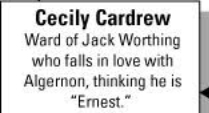
Cecily is the most attractive female character  she being the most attractive among all because Cecily is " a sweet,simple, innocent girl." Despite this supposed contrasts, it seems that the women in Oscar Wilde's play possess more similarities than differences.

If Gwendolen is a  product of London high society, Cecily is its antithesis. She is a child of nature,as ingenious and unspoiled as a pink rose, to which Algernon compares her in act ll. However,her ingenuity is belied by her fascination with wickedness. She is obsessed with the name Ernest just as Gwendolen is, but wickedness is primarily what leads her to fall in love with " uncle Jack's brother". Whose reputation is wayward enough ti intrigue her.  Like Algernon and Jack, she is a fantastic. She has invested her romance with Ernest and elaborated it with as much artistry ang enthusiasm as the men have their spurious obligations and secret identities. Though she does not have an alter- ego as vivid or developed as Bunbury or Ernest,her claim that she and Algernon/Ernest are already engaged is rooted in the fantasy world she's created around Ernest. Cecily is probably the most realistically drawn character who does not speak in epigrams. Her charm lies in her idiosyncratic cast of mind and her imaginative capacity, qualities that derive from Wilde's notion of life as a work of art. These elements of her personality make her a perfect mate for Algernon.


"You must not laugh at me, darling,but it had always been a girlish dream of mine to love someone whose name was Ernest. There is something in that name that seems to inspire absolute confidence. I pity any poor married woman whose husband is not called Ernest."

Yes they're so much alike they could be sisters- and now they will be. You might want to check out the " Gwen and Cecily" section of Gwendolen's . Part of what makes Cecily attractive to Algernon is seeming simplicity. She's not intellectual like Gwendolen,who very early on scold Jack "Ah! that is clearly a metaphysical. 


Cecily carded enters the play long before she makes her appearance on stage. Her guardian Jack describes her while confiding his secrets to Algernon moncrieff. Jack decides that his alter ego as a younger brother Ernest has to end. Jack seems to be dangling Cecily like bait, and the audience suspects how Algernon will respond. As Jack will no longer have use for Ernest, Algernon sees an opportunity to assume Ernest's identity and embody Cecily's  fantasies.

Cecily continues to confide her romantic dreams to Algernon, revealing that she, like  Gwendolen,feels attracted to the name Ernest. Her speech makes the audience wonder if Cecily and Gwendolen have been reading the same sentimental novel. As with Gwendolen, Cecily's fixation on the name comically complicates the plot, since no such persona  as Ernest Worthing actually exists.

Cecily consults Algernon about the new requirement set down by her guardian, Jack: she can't be  married without Jack's permission until she reaches the age of thirty- five. Algernon's willingness to wait years confirms  Cecily's suspicion of his  ambivalence about marriage. Soon after Cecily admits ahe doesn't know what will happen next, Lady Bracknell's final revelations take over the play and sort out the plot, including the future of Algernon and Cecily.

Conclusion :-

The Importance of Being Ernest is a capital-C comedy. It ends happily, resolving and tensions in such a way that all the characters get what they desire. This means that all secret identifies are revealed and all the couples can get married in socially acceptable way.

 Thank you...


Wardcount : 677

Absalom and achitophel

Absalom and achitophel :-John Dryden 

 I am going to talk about the characters in the poem Absalom and achitophel in who are favoured King David ( Charles ll) and those who are against him.

About poem :-

Absalom and achitophel is a celebrated satirical poem by John Dryden, written in heroic couplets and first published in 1681. The poem tells the Biblical tale of the rebellion of Absalom against King David; in this context it is an allegory used to represent a story contemporary to Dryden, concerning king Charles ll and the Exclusion crisis (1679 - 1681). The poem also references the Polish Plo by (1678) and the Monmouth Rebellion (1685).


 King David :-

The third king of Israel. David is a merciful and kind king who does not have a male heir to inherit the throne. As such, the crown with ascend down a "collateral line " after David's death to his brother. As he has several illegitimate some, but he loves Absalom the most, and the people of Israel like wise love Absalom and herald him as a national hero. David gives Absalom everything he wants, and he would give him the crown, too, if he could. Over time, however, David's dishonest counselor, achitophel, begins to stir up resentment for David and encourages Absalom to rise up against his father to ensure that David's brother will not ascend the throne. Both Absalom and achitophel confuse David's mild nature for weakness, and after David runs out of patience, he is forced to excerpt his God given power  over the people of Israel and remind Absalom, achitophel, and the people that he can strick them all down if he chooses. As David speaks to the Jews, a massive crack  of thunder is heard through the land ,and all of Israel knows David is their rightful king. Dryden's David is an allegory for king Charles ll  of England, and like David, Dryden argues that Charles has a divine right to the throne, which Charles's son,  the Duke of Monmouth tried to usurp in Dryden's time. Dryden was an ardent supporter of the monarchy and Charles ll, and his portrayal of David in  " Absalom and achitophel" reflects this support, but he does not depict David as perfect. On the contrary, Dryden in critical of Charles's leniency and even pokes fun at his rumoured promiscuity but Dryden nevertheless implies that Charles has been chosen  by God to be the king of England, and that right cannot be appropriated by parliament or the people.

King David 

"But when to sin ous baised nature learns,
The careful devil's still at hand with means 
And providently pimps for I'll desires:
The good old cause revived a plot requires 
Plots, true or false, are necessary things
To raise up commonwealths and ruin kings."

Make a list of character who were favoured King
David and those who were against him ?


Favoured Charles ll
 
 - Absalom
 - Saul
 - David's brother
 - Ishbosheth
 - Barzillai's Eldest son
 - Jotham
 - Amiel
 - Barzillai
 - Zodock
 - The Sagan of Jerusalem
 - Adriel
 - Hushai
 - Amnon
 - Michal

Against Charles ll

- Absalom
- Achitophel
- Corah
- Shimei
- Zimri
- The pharaoh
- Jonas
- Balaam
- Caleb
- Nadab

 Detail in characters :-
 
Absalom :- 

 David's beloved son who rebelled against him; stands for James ,the Duke of Monmouth, who sided with the Exclusionists against his father Charles ll.  He was executed for treason.

Achitophel :-

David's counselor who betrayed him and encouraged Absalom to rebel against his father. He hanged himself when he saw that the rebellion would not succeed. Ha represents Anthony Ashley Cooper, the first Earl of Shaftesbury.
 
Corah :-

Corah led a rebellion against Moses. He stands for Titus Oates, who devised the polish plot and led the persecution of Catholics.

Zimri :-

Two biblical  figures represents Zimri : a murderer in numbers,and a usurping murderer in l Kings. He is an allegory of George Villiers, the second Duke of Bucki gham.

Shimei :-

A man who curses David. He represents slingsby  Bethel, a Sheriff of London and Middlesex.

Jonas :-

Jonas or Jonah , he represents Sir William Jones the attorney general. He prosecuted Catholics in the early stages of the Polish Plot, became a member of parliament, and supported the Exclusion Bill.

Nadab :- 

Aaron's  eldest son; he was an idolater. He represents William,Lord Haward of Esrick, a puritan preacher.

Balaam :-

A prophet who ignored God. He represents Theophilus Hastings.

Saul :-

Saul was the first king of Israel; he defeated the Philistines in their first battle. He represents Oliver Cromwell, who ruled England after Charles's execution as Lord protector.

Jotham :-

Jotham stands for George Savile, Marquis of Halifax, and nephew of Shaftesbury. The Marquis of Halifax had once supported Shaftesbury but, alarmed at his excess, became a supporter of the court. It was entirely by his eloquence that the Exclusion Bill was defeated in the Lords in 1680.


Wardcount : 790


Thursday, 2 December 2021

Thinking activity : Hard Times - Charles Dickens


Hello readers!

I am discuss the theme of 'UTILITARIANISM' with illustrations from the novel.

Hard times is the tenth novel by Charles Dickens, first published in 1854. The book surveys English society and satirises the social and economic conditions of the era.


              " In Hard Times ,how does Louisa Gradgrind's marriage to Bounderby  set  an example of patriachal and utilitarian 'arrangement'  in Victorian society."

The theme of 'Utilitarianism' in Hard Times :

Utilitarianism is the assumption that human beings act in a way that highlights their own self-interest. It is based on factuality and leaves little room for imagination. Dickens provides three vivid examples of this utilitarian logic in Hard Times. The first; Mr. Thomas Gradgrind, one of the main characters in the book, was the principal of a school in Coketown.

            "I wish  I could collect all the Facts we hear 

       so much about, said Tom, spitefuly setting his

       teeth, and all the figures, and all he people who

       found them out, and  I wish I could put a

       thousand barrels  of gun power under them,

        and blow  them all up together! However, when

        i go to live with old Bounderby, I'll have my revenge."

He was firm believer in utilitarianism and instilled this philosophy into students at the school from very young age, as well as his own children. Mr. Josiah Bounderby was  also a practitioner of utilitarianism but was more interested in the profit that stemmed from it . At the other end of the perspective a group of circus members, who are the total opposite of utilitarian, are added by Dickens to provide a sharp contrast from the ideas of  Mr. Bounderby and Mr. Gradgrind.

Thomas Gradgrind sr., a father of five children, has lived his life by the book and never strayed from his philosophy that  life is nothing more than facts and statistics. He has successfully in incorporated this belief the school system of Coketown and has tried best  to do so with his own children.

The educators see children as easy target just waiting  to be filled with information. They did not consider, however, the children's need for fiction, poetry, and of the fine arts that are used to expand children's mind's, all of which are essential today in order to produce well rounded human beings through th educational process.

One has to wonder how different the story would be it Gradgrind did not  run the school. How can you give a utilitarian man such as Gradgrind such power over a town? I do like how Dickens structures the book to make one ask obvious questions such as these.

Dickens does not tell us much about the success of the other students of the school besides Bitzer, who is fairly successful on paper but does not have the capacity as a person to deal with life's everyday struggles. Gradgrind's two oldest children, Tom and Luisa, are examples of how this utilitarian method failed miserably.

These children were never given the opportunity to think for themselves, experience fun things in life, or even use their imaginations. True, they are smart people in the factual sense but do not have the street smarts to survive. Tom is a young man who,so fed up with his father's strictness and repetition revolt against him and leaves home to work in Mr. Bounderby's bank.

Tom now out from under his father's wing , begins to drink and gamble heavily. Eventually,to get out of a gambling dept,he robs a bank and is  forced to flee the area. When Bitzer realises that Tom has robbed the bank and catches  him,Mr. Gradgrind begs him to let Tom go, reminding him of all the hard work that was put on him while at the school.

Ironically Bitzer, using the tools of factuality that he had learn  in Gradgrind's school, replies that the school was paid for,but it is now over and he owes nothing more. In think this is extremely funny how, at  a time of need, Gradgrind's educational theory has backfired in his face. I think Dickens put this irony in as a comical device but also to show how ineffective the utilitarian  method of teaching is.

Louisa, unlike Tom, does get along with her father. She stays in the marriage with Bounderby and goes about  life normally and factually until she is faced with a dilemma and panics. Mr. James Harthouse ,  a young , good looking guy ,  is attracted to  Luisa and  deceivingly draws her attraction to him. She does not know what to do since she has never had feelings of her own before. Her father never gave her the opportunity to think for herself, or even love someone. This is why Luisa  goes frantic and ends up crying in her father's lap.

           " In the innocent of her brave affection,

             and the brimming up of her old devoted spirit,

              the once deserted girl shone like a beautiful light

              upon the darkness of the other."

She has always been told what to do and what is 'right', and now even her father is stumped. For the first time in the whole novel, Mr. Gradgrind strays from the utilitarian philosophy and shows compassion for his daughter and her feelings. One must think that he is beginning to doubt his philosophy after his seeing it backfire in his face more than once.

Dickens cleverly added circus people as a contrast to the utilitarian approach life. The circus people could be called the total opposite of utilitarianism. It one elements of the book stands out in mind,it would be this one.

The circus people are simple, open-minded human beings whose goal in life is to make people laugh. Dickens portrays them as a step from the " Hands" but still close to the bottom in the social structure. These people are hated  by Gradgrind, Bounderby and other utilitarians because they represent everything that is shunned in utilitarianism such as loves, imagination, and humor.

His method was somewhat indirect in the sense that he worked backward to get his point across but turned out to be very effective as the story proggressed. Most of the story revolved around utilitarianism and the study of cold  hard facts, but when the character flaws began to surface as a result of this philosophy, Dickens is quick to emphasize them.

One actually sees the main character of the book and firm supporter  of utilitarianism, Mr. Thomas Gradgrind experience the faults of his practice and begin to stray from it. Now, after watching his life fall apart, maybe he wishes he were in the circus.

 Thank you...!

Word count : 1,097


Thinking activity : Pamela : or Virtue Rewarded

 Pamela : or Virtue Rewarded - Samuel Richardson


Brief introduction About author :-

Samuel Richardson (1689 -1761) was a well known writer of the 18 th century. But before being a writer he was a printer. In 1738 his work as a printer was successful and a year later his friends asked him to write "a little volume of letters, in a common style, on such subjects as might  be of use to those country readers, who were unable to idite for themselves"; and it was when we was  writing this book that he was inspired for his first and  successfull novel "Pamela :Or, Virtue Rewarded". It took him five years to write his second  and also successfull novel "Clarissa, or the story of a young Lady". Between this two books he would also continue printing, and five years later his last book he published another novel " The History of Sie Charles Grandison". 

What is an Epistolary Novel ?

"Epistolary Novel, a novel told through the medium of letters written by one or more than characters. Originating with Samuel Richardson's Pamela or Virtue Rewarded(1740), the story of servant girl's victorious struggle against her master's attempts to seduce her , it was one of the earliest forms of the novel to be developed and remained one of the most popular up to the 19th century. The epistolary novel's reliance on subjective point of view makes it the forerunner of the modern psychological novel."


Pamela : Or, Virtue Rewarded :

This lesson provides an overview and three important things of Pamela :or Virtue Rewarded, a novel published by Samuel Richardson in 1740. We'll begin with a quick overview of the novel, including information on way it was so important for the 18th century; we will then walk through a  important things of the novel.

Overview :-  

Samuel Richardson's Pamela: or Virtue Rewarded gives us one of the eighteenth century's most famous love Stories though the novel may not sound very romantic to modern readers. In it, a rich gentleman named Mr. B relentlessly pursues the virginity of a beautiful and chaste serving  girl named Pamela. An unscrupulous rake Mr. B, wishes for nothing more than to have his way with the young girl. He repeatedly tries to rape and assault her. Unfortunately for Mr. B, Pamela is a paragon of virtue, and she always manages to escape his attacks. Eventually, Pamela's innate goodness reforms Mr. B, and he gives up his pursuit, instead offering her his hand in marriage. In a surprising twist, Pamela eventually accepts Mr. B's proposal and becomes the wife of her would-be rapist.

There are three important things you should know about this novel.

A Novel of Letters :-

Pamela: or Virtue Rewarded is an epistolary novel that is ,a piece of fiction comprised of letters. Why is this important? We'll, letters give us insight into a characters interior world; if we read a characters Letters,we begin to see how their inner life develops over time. Epistolary novels create characters who are well rounded and complex rather than flate and one dimensional. Promoting psychological depth, epistolary novels became all the rage in the eighteenth century and contributed to the growth of novel as  a literary form.

A Conduct Manual :- 

The second thing you should know is that Pamela: or Virtue Rewarded was written in the style of a Conduct manual. Richardson was heavily influenced by nonfiction text written to improve a person's moral character. The result? Richardson's novel, especially the second volume, is didactic; the book attempts to teach it's reader. Pamela is offered to readers as an example of virtue  because she is chaste and obedient to her family and God.

Social Change :-

The final thing you should know is that Pamela:or Virtue Rewarded reflects anxieties about society in eighteenth century England, namely the country's changing class structure just think about it. Pamela starts off as a regular nobody,and she ends up living in a fancy hours with a rich  husband. This may not seem like a big deal to us, but the story was quite shoking for many eighteenth century readers who weren't used to social mobility. The novel argues that regardless of her rank, Pamela has innate value; this message appealed to growing numbers of middle class readers. 

Theme of Pamela :-

Pamela covers a variety of social themes such as the social classes of English society,the importance of chastity, virtue and femininity religion,a bit of Feminism , and of course love and marriage. As a servant girl about to marry a nobleman , Pamela wishes to be accepted into the aristocracy.


Thank you...


Word count - 763

Thinking activity : The Romantic Poets

 The Rime of the Ancient Mariner :-

About poem :-


          Day after day, day  after day,
          we stick, nor breath nor motion;
          As idle as a painted ship
          Upon a painted ocean."

The Rime of the Ancient Mariner ( originally " Rime of the Ancyent Mariners ")is the longest major poem by English poet Samuel Taylor Coleridge, written in 1797-98 and published in 1798 in the first edition of Lyrical Ballads. Modern editions use a later  revised version printed in 1817 and featuring a gloss. Along with other poems in Lyrical Ballads, it was a signal shift to modern poetry and the beginning of British Romantic literature.

Poetic form : Lyrical Ballads :-
" The Rime of the Ancient Mariner " is a celebrated literary Ballad or narrative poem written in deliberate imitation of the traditional folk ballad. Like older ballads, Coleridge's masterpiece features sensational subject matter the perilous journey of an old sailor. It also contains other conventional elements : dialogue, repetition of words and phrases,and strong pattern of rhyme and rhythm. However,there are aspects of the poem that reflect Coleridge's own romantic writing style: his emphasis on the supernatural, his sophisticated use of sound devices, and his use of archaic language. For example, notice his description of a mysterious ghost ship:
              " Speck, a mist, a shape , I wist! 
                 And still it neared and neared:
                 As if it dodged a water-sprite,
                 It plunged, and tacked and veered."

As you read  "The Rime of the Ancient Mariner", observe how Coleridge reworks the traditional ballad form and creates a poem of rare beauty and complexity.

Setting :-
 
Just as the poem has two different narratives, it also has two different settings. The first setting is outside the wedding hall. There is no way to know in what year or even century the poem takes place, but it must have been after the Age Exploration, because the Mariner describes a voyage all the way down to the Antarctic. As for the place, we know the Mariner and the wedding guest come from  somewhere in the  British Isles, but not exactly where. Judging by the use of the Scottish word " Kirk", and the  fact that ballads were popular in Scotland, this poem could be set in that region.

The wedding, quite frankly, sounds like a rockin time. There's singing, dancing, drinking and a whole lot of marry making. But we only hear all this revelry behind closed  doors. The wedding guest is sitting on a rock outside the feast and maybe he  catches a glimpse or two  of  the party when people enter or leaves. But  that's it. Otherwise he's just sitting in the darkness listening to a grizzled old man with magnetic eyes.

The setting of the Mariner's story,on the other hand,is full  of spectacular Scenery and supernatural elements. Special emphasis is put on the weather and on astrological phenomena like the sun, moon and stars. These are obviously things of great concern for sailors. The story begins in the bay with the receding shoreline. The boat travels down to the equator and then to the Antarctic Ocean, where they run into trouble in an ice field. The ice is cracking and grounding all around them.

And what about that Ocean?  The Rime of the Ancient Mariner is set in time  when, once you crossed a certain point in your ship, you would expect not to see other people for a long, long time. As in many works of literature, like Herman Melville's Moby-Dick, the ocean represents the mysteries of the human soul and if you want to get all Sigmund Freud about it,the unconscious. Just like the  sea, an individual's personality is often like a flat, uniform surface that conceals and deepness filled with those  bizerre  and often unsightly creatures we call emotions or desires. So, when the Mariner pollutes  his soul by killing the albatross, it's not  a surprise to see that the ocean becomes polluted with slime and horrible creatures. Moreover, the imaginary of the vast, vacant ocean, particularly once the rest of the crew has died, expresses  a condition of spiritual solitude and loneliness. It's the kind of setting that makes you realise we're truly all alone in this world, with seemingly infinite depths above and below us.

After the Mariner breaks the curse against him, the strange colors on the ocean disappear,but then  a bunch of angels turn the poem into a zombie movie, amid a crazy night time light show with lighting and the Aurora, taking over the bodies of the sailors. They create their own retraces it's steps,moving back to the equator,and then , with the return of the wind ,to the bay where the story started. At this point, the story- within-a-story ends, and we return to scene of the wedding feast. Taken as a whole,the setting traces an are from the wedding to Antarctica and back again.

Theme of The  Rime  of the Ancient Mariner :-

The main themes in "The Rime of the Ancient Mariner" are sin and penance, the power of prayer, and mystery and the supernatural.

Sin and penance :-
After sinning by killing the albatross,the Mariner must atone through suffering. As such, is condemned to wander the world , telling his  stor of woe.

Power of Prayer :-
Prayer which Coleridge links to love is presented as vital, even in the midst of despair.

Mystery and the Supernatural :-
The supernatural elements of the poem underscore ots urgency as a  story of sin and belief.

Characters :-

Night- mare Life- in-Death
The Mariner
Pilot
Death
Wedding Guest

Major conflicts :-

The conflict of the narrative poem begins the Mariner shoots the  albatross who had  just led the ship to safety. Not only is the ship's crew angry with him but the  Mariner also faces the wrath of the spiritwho seek to punish him for this act.

 To read more about the original poem : The Rime of the Ancient-Mariner. https://www.poetryfoundation.org/poems/43997/the-rime-of-the-ancient-mariner-text-of-1834

Thank you !...


Word count :- 990

How Literature Shaped Me?

  What is Literature? Literature is considered by many as the most effective means to comprehend the world. This is because it has been desc...